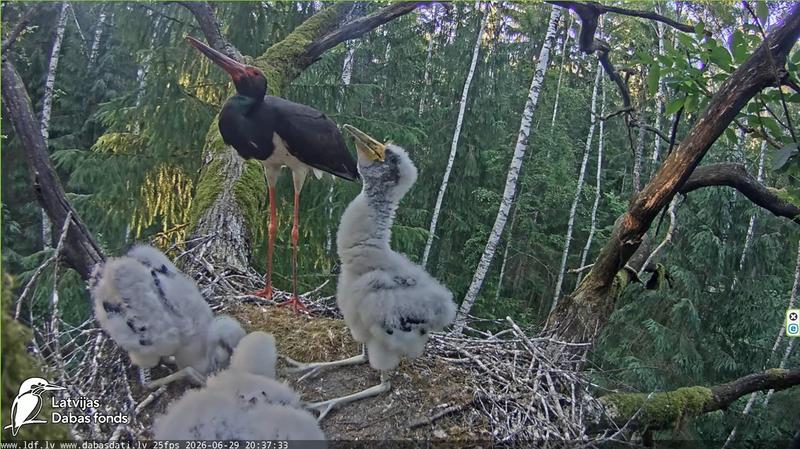
Meija provided feeding as well, but she attacked the chicks again. As I wrote before, there could be multiple reasons for this.
Feedings took place at: 7:49 O, (8:24 maybe Meija landed on the nest tree), 17:23 (O), 17:58 Meija; 20:56 Ogris. The feedings were good, and the chicks are doing fine. The chat is still discussing the situation, both factually and emotionally.
rain is expected in Latvia: @Feja-1 vispār sola lietainu laiku nākošās dienas. (Generally speaking, rainy weather is expected in the coming days.)
After a brief consultation with an AI tool about how the rainfall affects the food supply, here is an ecological overview we put together: The Impact of Rainfall on Black Stork Foraging Ecology
1. During the Rain: Short-Term Disruption
Heavy rainfall and wind significantly disturb the water surface, reducing underwater visibility. Consequently, fish tend to retreat to deeper layers or seek shelter among submerged roots. Furthermore, surface runoff often introduces sediment into forest streams, making the water turbid. Since Black Storks rely primarily on visual detection when tactile hunting is insufficient, foraging efficiency temporarily drops during the downpour.
2. Immediately After the Rain: An Abundance of Amphibians
The increased humidity and drop in atmospheric pressure stimulate high activity among amphibians. Frogs, toads, and newts emerge from their terrestrial shelters in the moss and undergrowth to migrate across wet meadows and forest paths. For the parent storks, this creates highly accessible foraging grounds, allowing them to collect high-protein prey efficiently without the need for deep wading.
3. Availability of the New Fish Generation (Late June Context)
Regarding fish dynamics at this stage of the season, two main factors apply:
The Spring Generation: Most freshwater fish species in the Baltic region (such as pike, roach, and perch) spawned in April and May. Their fry have already grown to several centimetres in length. The post-rain rise in water levels frequently flushes these small fish into shallow, temporary pools and oxbows, where they become trapped and represent an ideal, easily catchable food source for storks.
Late-Season Spawning: Certain species (e.g., crucian carp or tench) exhibit fractional spawning, which is triggered by peak water temperatures in June and July. A warm summer rain, accompanied by a slight rise in water levels, can initiate this late spawning wave. While the resulting tiny fry appear too small for mature chicks, the overall dynamics ensure a stable and diverse food supply in the system.
Given that the chicks in the Latvian nest are currently around 26 to 28 days old, their metabolic demands are peaking. This post-rain increase in both amphibian and fish availability provides the parents with an excellent opportunity to meet the high dietary requirements of the rapidly growing brood.
Additional Note on Adult Flight Mechanics and Behaviour during Heavy Rain:
During intense or prolonged rainfall, adult storks actively minimise their movements and avoid unnecessary flights. If their plumage becomes completely saturated, the added water weight significantly increases their wing-loading, making flight physically exhausting and severely reducing their aerial manoeuvrability. Flying under these conditions drastically elevates the risk of accidents—such as misjudging distances or losing altitude control—which can lead to severe or even fatal collisions with man-made structures like power lines or dense forest canopy. Consequently, staying sheltered and waiting out the storm is a critical survival strategy for the parents.
The female's behaviour has been a real roller-coaster. One day she takes care of the nestlings properly, and the next day we observe displays of aggression towards the chicks again.