Ogre Municipality (Vidzeme Region)

Post Reply
marika.solo
Site Admin
Posts: 26657
Joined: 29 Sep 2021, 09:38

Re: Ogre Municipality (Vidzeme Region)

Post by marika.solo »

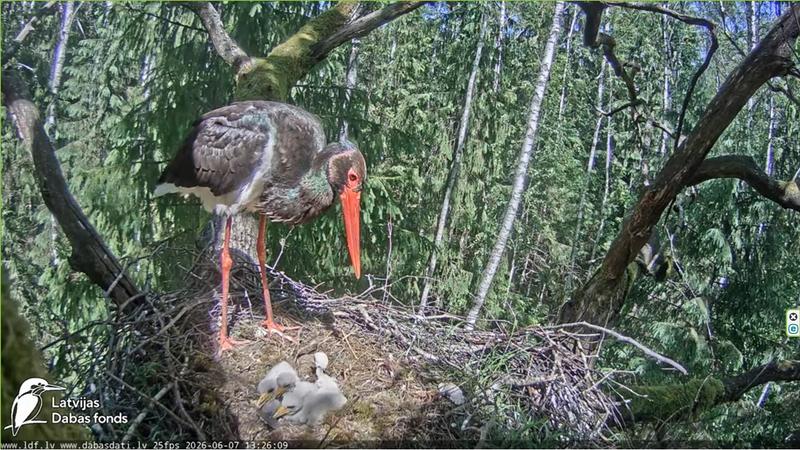
Strength — which in young black storks is essentially identical to body weight at fledging — is crucial for survival. That’s why raising only three storklets is usually the best outcome.
(these storklets are a bit late and what we can expect in Pärnu - Kergu and Kerli :? )

Stork chicks grow exponentially. 90 days in the nest is like 18-21 years for humans. This means that 1 day in the nest is like almost 3 months for a human child.

Sometimes miracles happen ... our hearts are always with the weakest
Image
marika.solo
Site Admin
Posts: 26657
Joined: 29 Sep 2021, 09:38

Re: Ogre Municipality (Vidzeme Region)

Post by marika.solo »

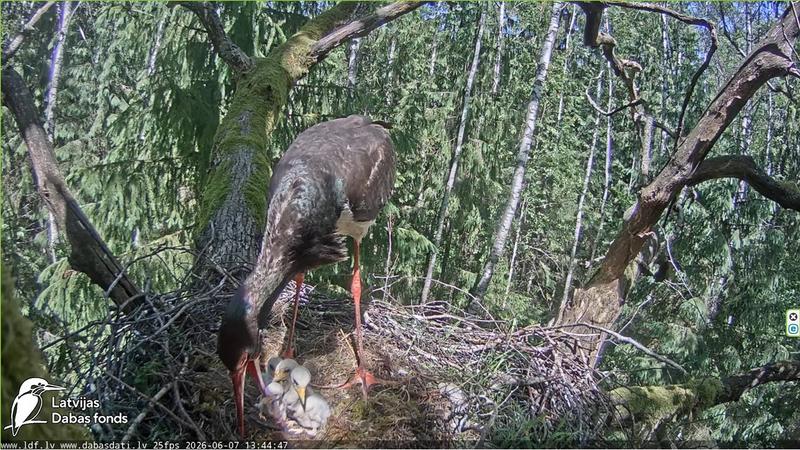
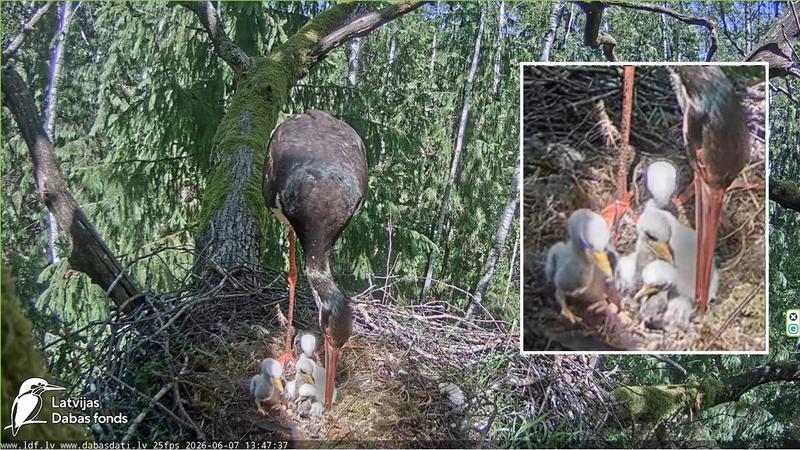
Feeding at 13:44

13:47 Benjamin has eaten :-) little crop is the first time really fully

first in row
Image

full crop
Image
marika.solo
Site Admin
Posts: 26657
Joined: 29 Sep 2021, 09:38

Re: Ogre Municipality (Vidzeme Region)

Post by marika.solo »

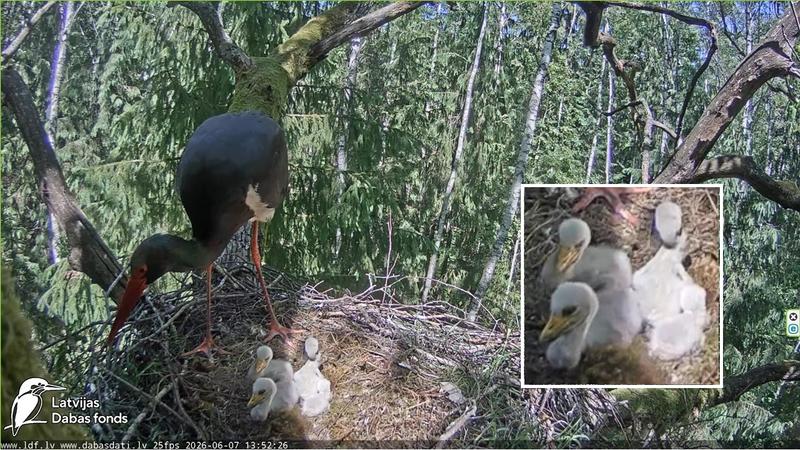
will see ... Benjamin is still much, much smaller

Image
marika.solo
Site Admin
Posts: 26657
Joined: 29 Sep 2021, 09:38

Re: Ogre Municipality (Vidzeme Region)

Post by marika.solo »

The male Ogris and the female Meija are watching little Benjamin very closely. They keep touching him, almost as if they want to grab him. At 18:51 Meija even rolled him a little bit away from the other chicks, but the youngest one managed to get back to them.

Hopefully, things will calm down. However, as I wrote before, it is better to raise three strong chicks than four weak ones (the third chick is also a bit small and behind).

Currently, Meija only brings big frogs. The two smaller chicks cannot catch and swallow them. Only Ogris brings small fish that they can actually eat.

Why the parents are hesitating with "brood reduction":

- Instinctive Conflict: For an adult stork, harming or removing its own chick is extremely difficult. It goes directly against their strong instinct to protect and warm everything that moves and chirps in the nest. This is why we see only "gentle" moving or testing with the bill. It is a sign of this internal conflict.

- Waiting for Natural Development: Parents often wait to see how the situation develops on its own. If the youngest chick is small but still active and fighting, the parents will give it a chance. They usually make a radical decision only if there is a severe lack of food and the older chicks start to starve, or if the youngest one stops moving completely.

-----
more scientific information to brood reduction and parental infanticide here: viewtopic.php?p=943#p943
marika.solo
Site Admin
Posts: 26657
Joined: 29 Sep 2021, 09:38

Re: Ogre Municipality (Vidzeme Region)

Post by marika.solo »

assisted by Gemini

Frogs as Food for Black Stork Chicks: Pros, Cons, and the "Female Trend"

The Age Factor: Pros and Cons

- Negative for Newborns (0–10 days old): Frogs have a wide body and long legs. For a tiny 2-day-old chick like Benjamin, they are mechanically impossible to swallow. They can block the small throat, risking suffocation.

- Positive for Older Chicks (2 weeks+): Once the chicks grow, frogs become excellent food. They are packed with protein and calcium from the bones, which is essential for fast skeletal growth and strong wings.

Why Do We See So Many Frogs This Season? (Latvia, Poland, Estonia)

- Weather and Local Water Levels: If local forest streams are too shallow or temporarily dry, fish move away or hide. However, damp forests and wet grass are full of frogs. The parents must catch what is available nearby.

- Different Hunting Strategies (Males vs. Females):
Males (like Ogris) often fly further to larger, deeper rivers or specific streams where small fish gather. They are willing to travel more for high-quality newborn food.
Females (like Meija) prefer to hunt closer to the nest to save energy and return quickly to guard or shade the chicks. Since the nearby forest floor offers plenty of frogs, they bring what is easiest to catch in high numbers, even if the size is not ideal for the youngest one yet.
marika.solo
Site Admin
Posts: 26657
Joined: 29 Sep 2021, 09:38

Re: Ogre Municipality (Vidzeme Region)

Post by marika.solo »

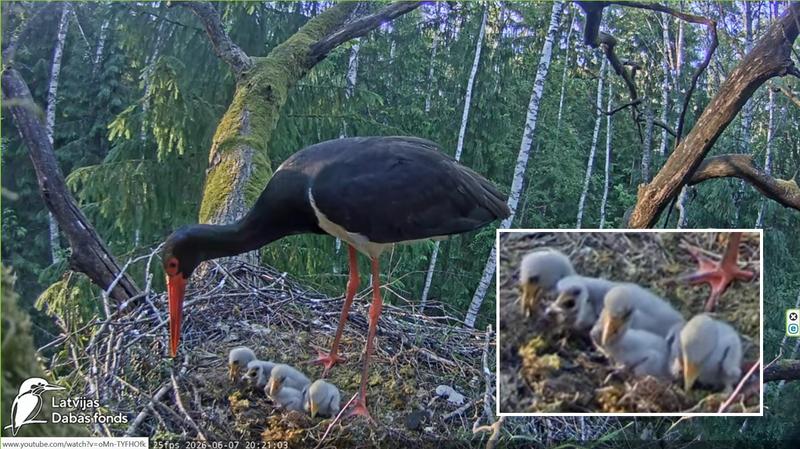
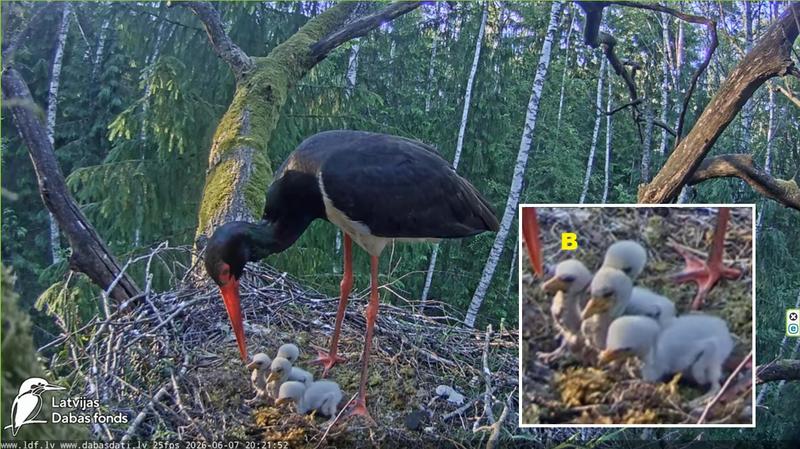
20:21 feeding - male Ogris; probably tadpoles - the best food for the little one

Image

(B = Benjamin, the 4th hatched chick)
Image
marika.solo
Site Admin
Posts: 26657
Joined: 29 Sep 2021, 09:38

Re: Ogre Municipality (Vidzeme Region)

Post by marika.solo »

previous post (07.06)
next ()


June 08
Hello everyone :-)

CHICKS 🐥🐥🐥🐥

- 1st chick: 7 days old (hatched 01.06 at 06:13)
- 2nd chick: 7 days old (hatched 01.06 at 13:14)
- 3rd chick: 5 days old (hatched in the night 02./03.06)
- 4th chick: 3 days old (hatched 05.06 at at 04:50)

dabasdati forum: https://forums.dabasdati.lv/viewtopic.p ... 58#p453458
marika.solo
Site Admin
Posts: 26657
Joined: 29 Sep 2021, 09:38

Re: Ogre Municipality (Vidzeme Region)

Post by marika.solo »

It is a hard choice for both adult storks between keeping all chicks alive vs raising the strongest.

These big frogs brought by Meija are too large for the little benjamin. Storklet misses many meals, and the size difference is still very huge.
Little benjamin is fighting with these large frogs during every feeding - unfortunately without success. Poor chick.
marika.solo
Site Admin
Posts: 26657
Joined: 29 Sep 2021, 09:38

Re: Ogre Municipality (Vidzeme Region)

Post by marika.solo »

youtube chat - Verotaja (translated - gemini)

The more I watch different storks, the more it seems that the indicator is not exactly the youngest chick, but the older ones. The parents use that little nibbling to check how well-fed the older ones are... (cont.)
... It is possible that when the older ones become too weak in the parents' view, a mechanism is triggered to reduce the number of chicks so that the older ones can eat better. This is how it all looks to me.


Verotaja, great observation, thank you! The condition of the older chicks, who are the most important, is indeed the main indicator of food availability. ​​Our attention is usually fixed on the youngest chick because we worry about it, so we often miss this perspective.
marika.solo
Site Admin
Posts: 26657
Joined: 29 Sep 2021, 09:38

Re: Ogre Municipality (Vidzeme Region)

Post by marika.solo »

Why do the parents monitor the OLDER chicks?

Main parental investment:
From an evolutionary perspective, the first two or three chicks are the ones into which the parents have already invested the most energy (they were incubated the longest and received the most food). They are the parents’ “primary investment” that must survive and fledge.

Indicator of resource availability:
If the oldest chicks are strong, active, begging aggressively and growing fast, it signals to the parents that food resources are sufficient and their investment is safe. In such conditions, they tolerate even the fourth chick, because the “leftovers” from feeding the older ones are enough for it to survive.

Alarm when older chicks weaken:
When a parent (for example while preening them or watching their behaviour) notices that the first two chicks are becoming lethargic, weak, or their growth slows down, an evolutionary alarm is triggered. It means that food in the area is critically limited.

Shift in strategy:
At that moment, the youngest chick stops being seen as a “bonus” and becomes a threat to the survival of the older ones. The parents immediately switch strategy and carry out active brood reduction.
Post Reply

Return to “Latvia”