05:49 – The female arrives and perches on a branch. 05:51 – The female enters the nest. 05:53 – Feeding by the female. 05:55 – The female departs.
07:10 – The male arrives. 07:13 – Feeding by the male. 07:14 – The male departs.
07:52 – The male arrives and brings nest material (moss/branch). 07:54 – The male departs.
07:56 – The male arrives and brings more moss. 08:02 – The male departs.
08:45 – The male arrives. 08:55 – Feeding by the male. 08:59 – The male departs.
11:21 – The male arrives. 11:29 – An unidentifiable bird flies near the nest. 11:30 – The male departs.
13:11 – Observer note: A parent arrives at the nest, preens its own feathers first, and does not provide any food. The chicks are begging for food but receive none.
18:24 – Male arrives at the nest, bringing moss/grass as nesting material.
18:25 – Male departs.
18:28 – Male returns to the nest and provides water (hydration) to the chicks.
18:29 – Male departs.
18:36 – Female arrives at the nest; both parents are simultaneously present.
18:44 – Feeding: Chicks are fed with large fish.
18:58 – Female departs.
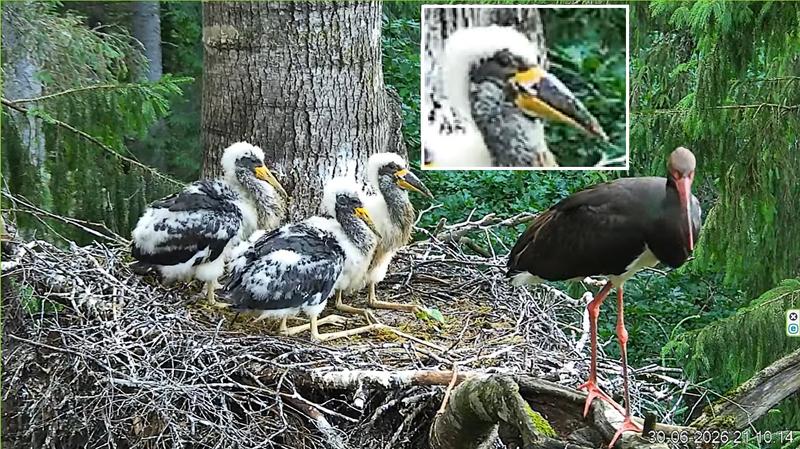
21:07 – Female arrives at the nest.
21:09 – Feeding: Female delivers food to the chicks.
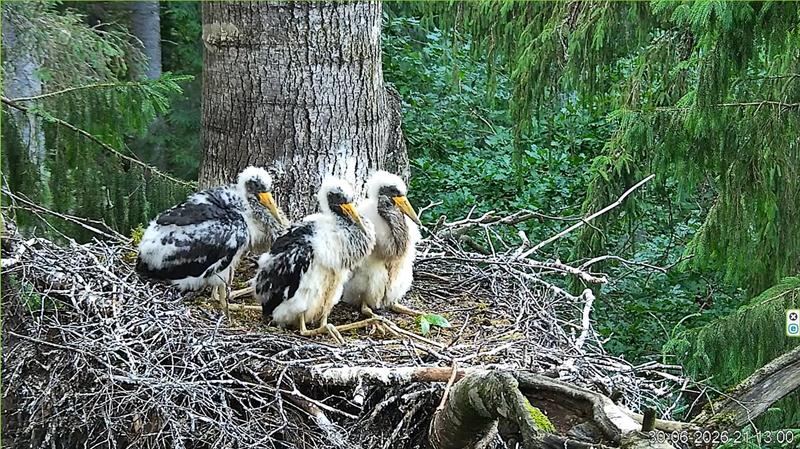
21:12 – Female departs.
Key Takeaways:
Technical Disruption: The stream was offline for nearly three and a half hours (from 14:46:30 until 18:14:30).
Hydration and Material: Shortly after the broadcast resumed, the male showed active care by bringing grass to line the nest, followed by a quick return to deliver water to the chicks.
Parental Overlap: Both parents met at the nest at 18:36, leading to an abundant feeding session with large fish. The female returned for another short visit after 21:00 to deliver a late feeding.
CHICKS () ()
- 1st chick: 38 days old (hatched late evening 24.05)
- 2nd chick: 37 days old (hatched early morning 25.05)
- 3rd chick: 37 days old (hatched afternoon 25.05) Brood reduction by male
- 4th chick: 20 days old (hatched late evening 26.05)
- 5th chick: 17 days old (hatched afternoon 28.05)
prof. Zielinski (youtube chat info):
The direct cause was that male brought an insufficient amount of food, resulting in nutritional stress, which is the biological trigger that prompts adult birds to start the process of brood reduction.
Stork chicks grow exponentially. 90 days in the nest is like 18-21 years for humans. This means that 1 day in the nest is like almost 3 months for a human child. That is why their transformation is so amazing and fast.